
| Technical Name | Equipping Drones with Fruit-Fly-Inspired Vision: A Low-Power Neuromorphic AI Chip for Real-Time Obstacle Avoidance | ||
|---|---|---|---|
| Project Operator | National Tsing Hua University | ||
| Project Host | 鄭桂忠 | ||
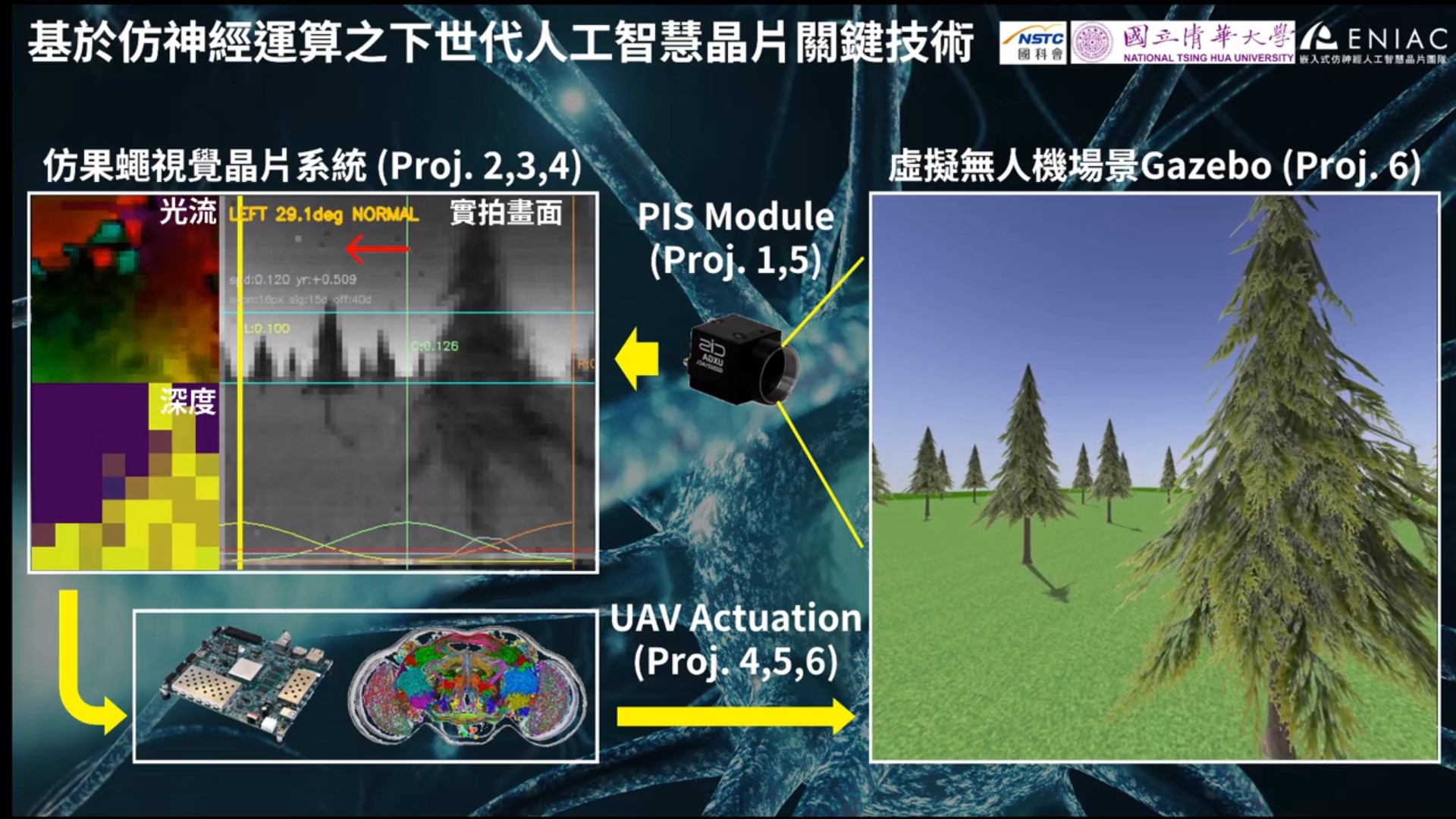
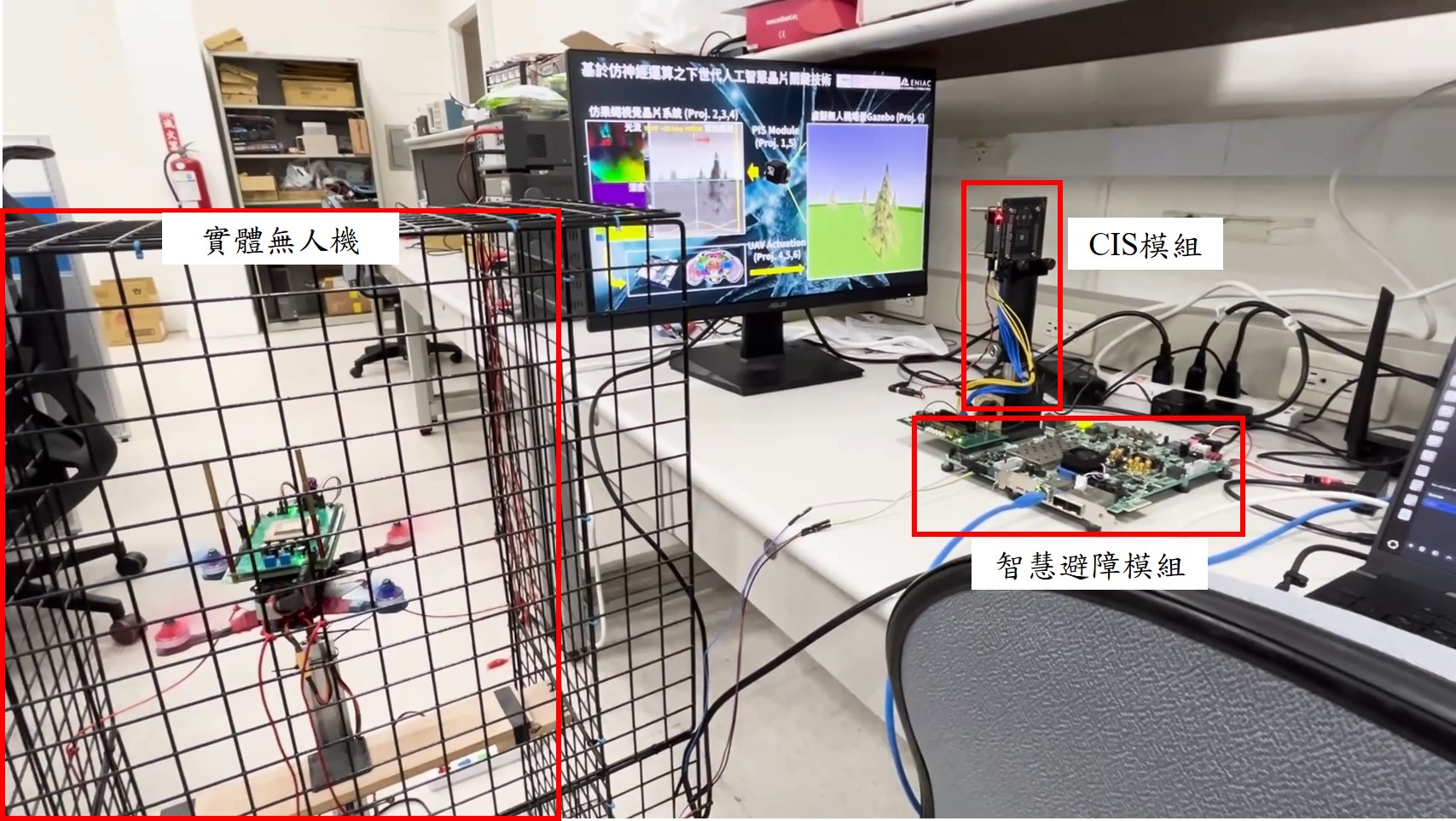
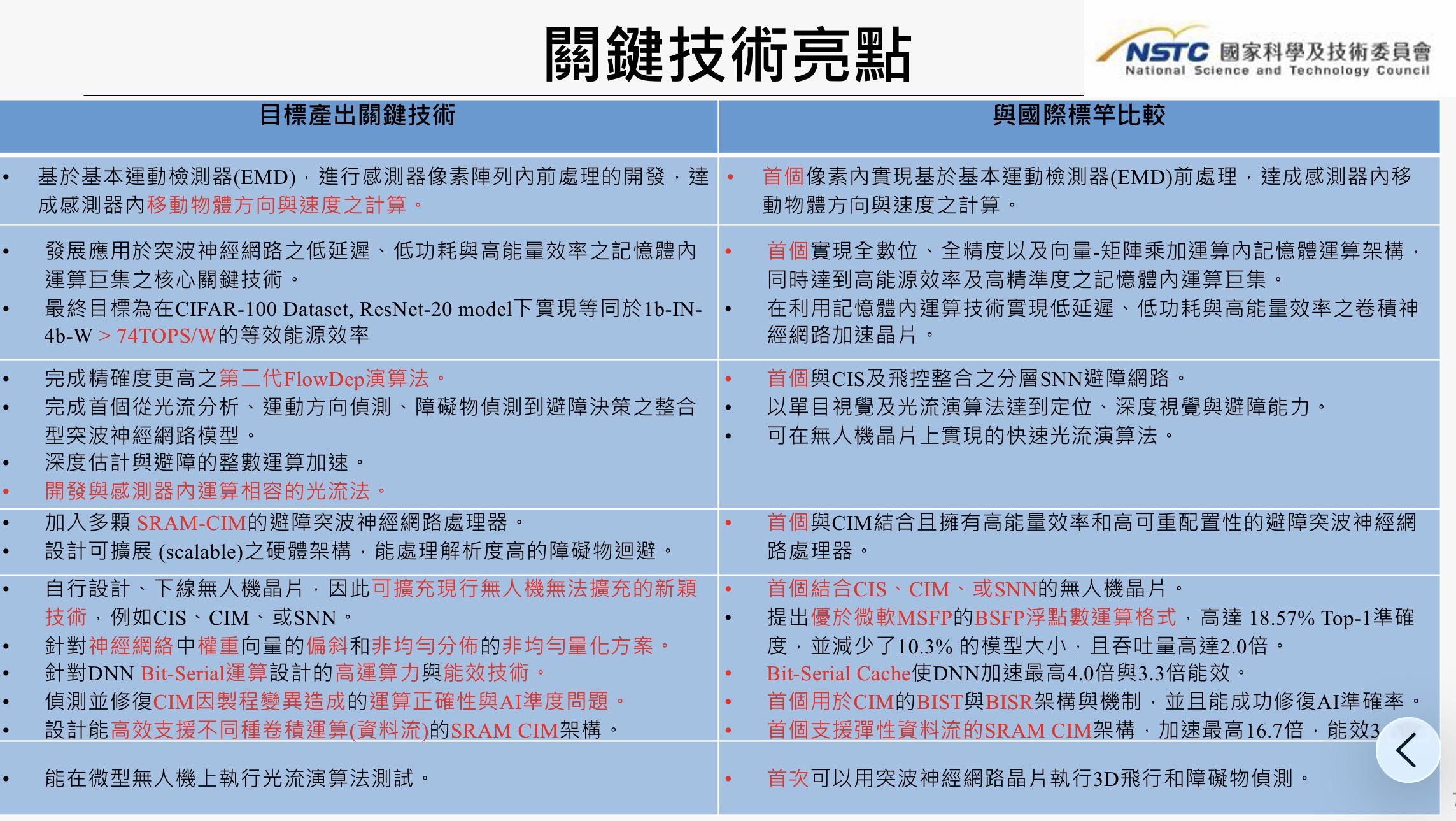
| Summary | “Giving Drones the Eyes of a Fruit Fly” is a low-power neuromorphic AI system for real-time obstacle avoidance on micro drones. The system integrates CMOS image sensors (CIS), Spiking Neural Networks (SNNs), optical-flow depth estimation, and Computing-in-Memory (CIM) for energy-efficient edge AI processing. The 16nm SNN chip achieves 82.24 TOPS/W, while the system demonstrates 100% obstacle avoidance at 2 m/s flight speed. This technology enables low-power autonomous navigation for drones. |
||
| Scientific Breakthrough | The proposed system integrates low-power CMOS image sensors (CIS), Spiking Neural Networks (SNNs), and Computing-in-Memory (CIM) for real-time drone obstacle avoidance. The 16nm SNN chip achieves 82.24 TOPS/W at 200MHz, while the SRAM-CIM architecture reaches 444.21 TOPS/W in SNN mode. The CIS supports on-sensor motion extraction with 312.5 fps optical-flow estimation. Integrated with optical-flow depth prediction, the system achieves 100% obstacle avoidance at 2 m/s. |
||
| Industrial Applicability | This technology integrates CMOS image sensors (CIS), Spiking Neural Networks (SNNs), and Computing-in-Memory (CIM) to build a low-power real-time obstacle avoidance system for drones and edge AI devices. Compared with LiDAR- and CNN-based solutions, it offers lower power consumption, lower latency, and reduced hardware cost. The system can be applied to smart agriculture, autonomous logistics, intelligent surveillance, and disaster response applications. |
||
- Contact
- Tzu-Hang, Huang
- harry92518@gmail.com
other people also saw