
| Technical Name | Embedded Analog Flash Programming-Based Edge Intelligent Sensing Chips with Event-Driven Sensing and Analog Token-Direct Conversion Recurrent Neural Network for Low-Power Low-Latency Computing | ||
|---|---|---|---|
| Project Operator | National Yang Ming Chiao Tung University | ||
| Project Host | 彭盛裕 | ||
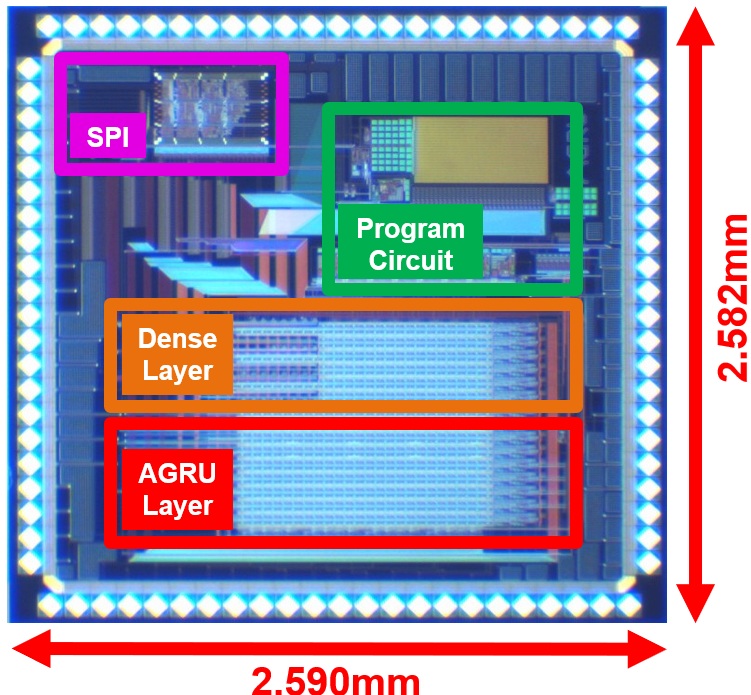
| Summary | We develop an analog recurrent neural network and an event-driven adaptive front end using embedded analog flash memory fast-programming technology. It directly converts continuous-time analog sensor waveforms into tokens, eliminating the latency and power consumption associated with digital memory and data movement. It meets edge intelligent sensing requirements with ultra-low power, low latency, and high performance, uitable for wearable healthcare, industrial IoT, and autonomous vehicles. |
||
| Scientific Breakthrough | This technology integrates a continuous-time analog gated recurrent neural network, precise fast embedded analog flash programming, and an event-driven sensing front end to directly convert analog sensor waveforms into tokens. By eliminating analog-to-digital conversion and extensive digital data movement, it also introduces an event-driven current self-adaptive analog circuit that achieves low power, low latency, and high performance, demonstrating potential for intelligent edge applications. |
||
| Industrial Applicability | This technology leverages flash memory and CMOS process to realize an low-power, low-latency analog recurrent neural network chip. With event-driven adaptive sensing, it directly processes continuous analog sensor signals and removes the power and latency bottlenecks caused by ADCs and data movement. It is suited for smart healthcare, edge IoT, autonomous vehicles, intelligent robotics, and industrial automation, enabling long-term monitoring, real-time alerts, and efficient edge inference. |
||
- Contact
- Sheng-Yu Peng
- speng@nycu.edu.tw
other people also saw