
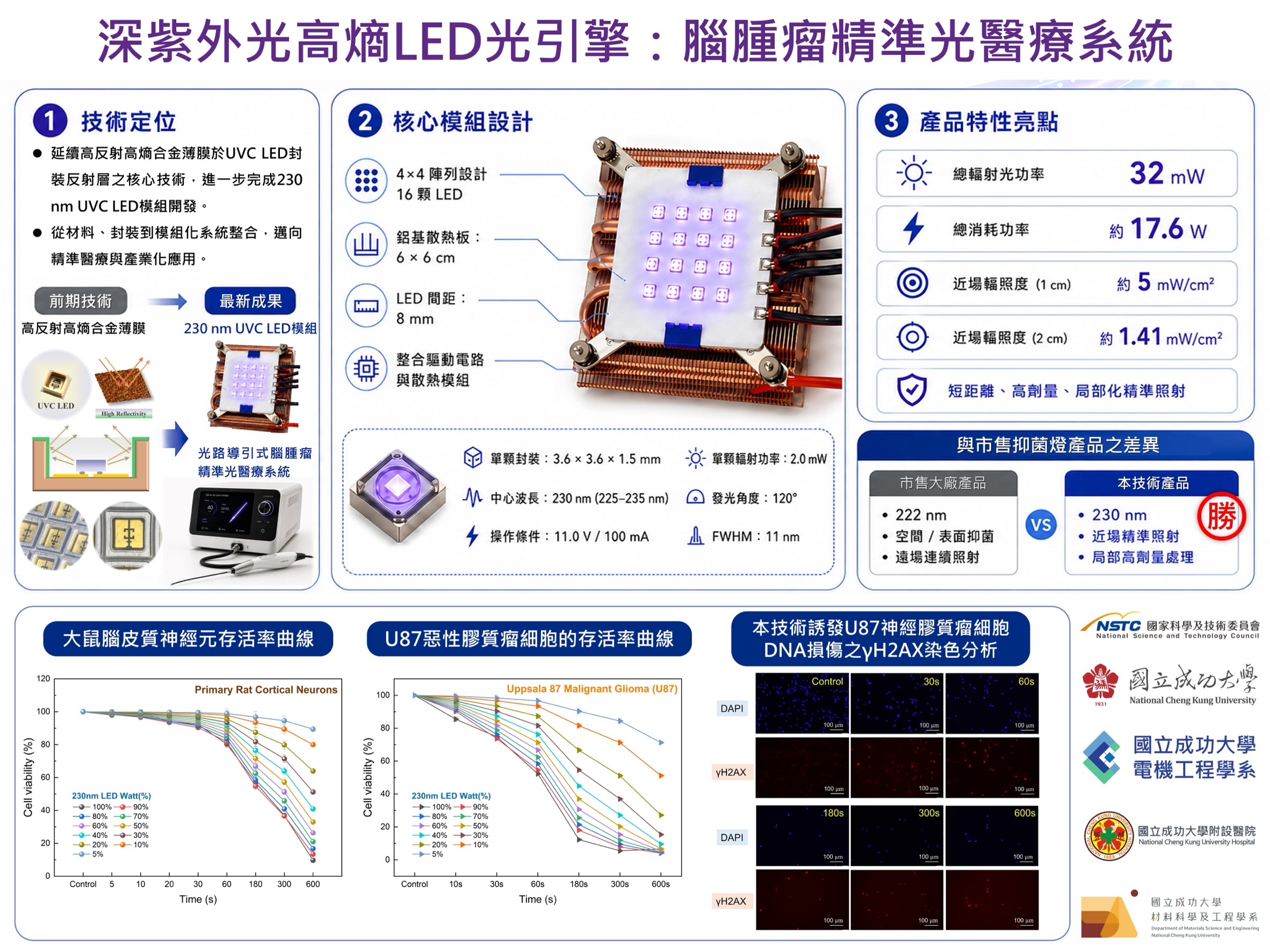
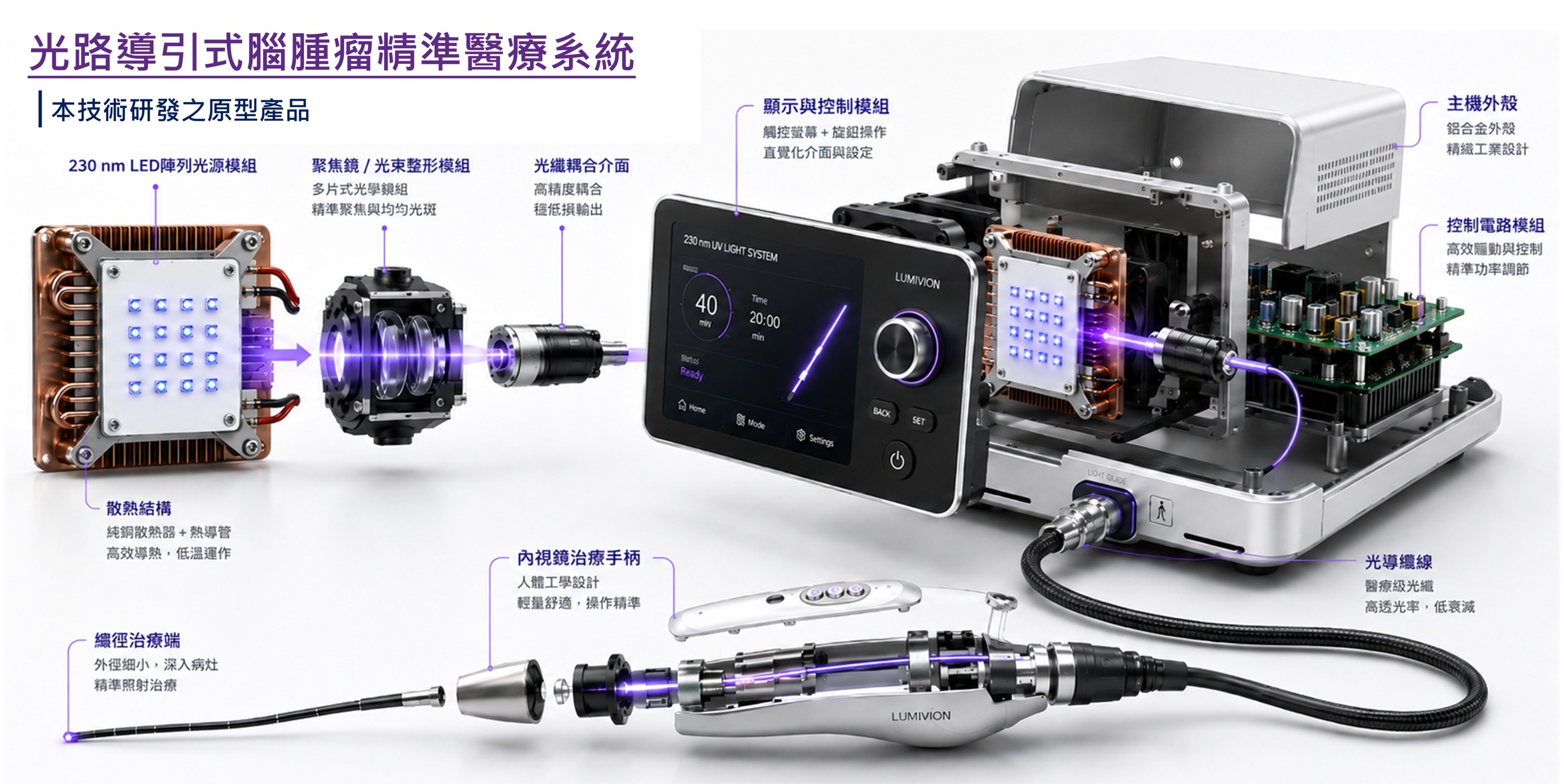
| Technical Name | Deep-Ultraviolet High-Entropy LED Light Engine: A Precision Photomedicine System for Brain Tumors | ||
|---|---|---|---|
| Project Operator | National Cheng Kung University | ||
| Project Host | 施權峰 | ||
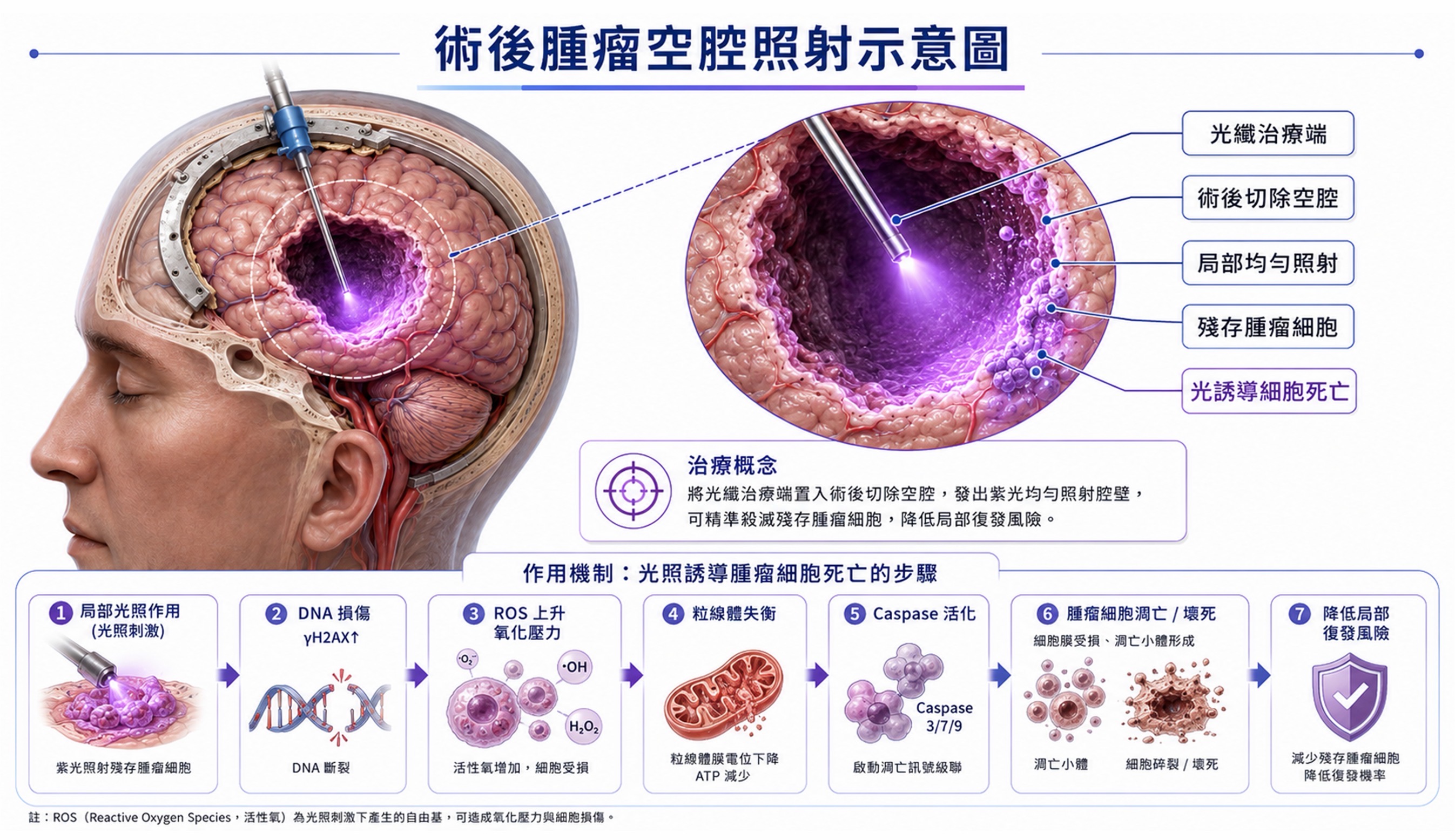
| Summary | This technology uses Al-Zn-Co-Ni high-entropy reflective films to overcome deep-UV LED packaging bottlenecks, integrating a 230 nm UVC-LED with the LumiTraceX light-guided system. Supported by domestic and international invention patents and an NT$5 million technology and patent transfer, hospital validation shows selective U87 tumor-cell inhibition, neuronal protection, and E. coli inactivation, advancing a precision photomedicine device system for surgery. |
||
| Scientific Breakthrough | This technology uses computational materials science to design high-entropy, high-reflectance films that overcome deep-UV LED packaging bottlenecks. It integrates a 230 nm UVC-LED module, controllable optical dose, and light-guided irradiation to develop a prototype brain-tumor precision photomedicine system. Unlike far-field antimicrobial products, it targets near-field surgical-cavity irradiation and validates use through selective U87 inhibition, γH2AX evidence, and bactericidal log values. |
||
| Industrial Applicability | This technology centers on a light-guided precision medical system for malignant brain tumors, integrating a 230 nm UVC source, adjustable optical dose, and fiber-optic treatment end for post-resection neurosurgical cavities to treat residual lesions locally and disinfect surgical sites in real time. Supported by hospital U87/neuron/E. coli data and an NT$5 million technology and patent transfer with a major light-source module company, it upgrades precision medical devices for operating rooms. |
||
- Contact
- Chuan-Feng Shih
- cfshih@mail.ncku.edu.tw
other people also saw