

| Technical Name | GraphStrux: A Graph-Driven System for Automated Building Structural Modeling, Rapid Analysis, and Design Automation | ||
|---|---|---|---|
| Project Operator | National Center foe Research on Earthquake Engineering, NIAR | ||
| Project Host | 陳俊杉 | ||
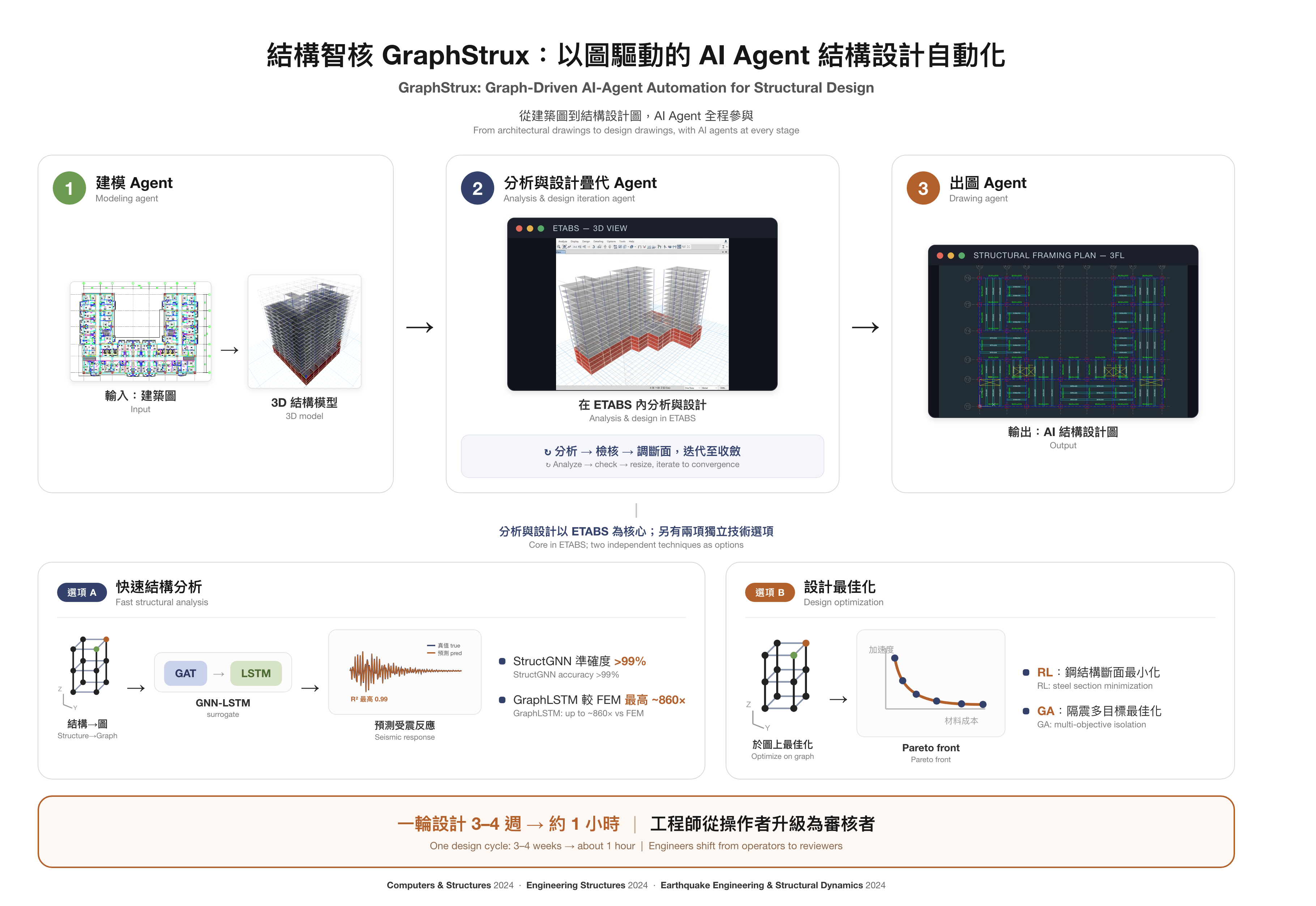
| Summary | In earthquake-prone Taiwan, seismic design is slowed by tedious workflows, and structural design firms face a manpower bottleneck. GraphStrux uses AI agents and graph neural networks to unify the drawing-to-design workflow—modeling, analysis, design, and code checking: guided by domain knowledge, it builds models, runs analysis and checks, and outputs design drawings. In tested cases, it compressed 3-4 weeks of iteration into about an hour, speeding up design while easing the shortage. |
||
| Scientific Breakthrough | At its core is an agent system that, guided by structural engineering knowledge and codes, autonomously reasons through and runs the full structural design workflow—delivering the first fully automated seismic design. The pipeline also integrates a self-developed graph neural network surrogate that predicts nonlinear seismic responses fast and accurately, and uses genetic algorithms and reinforcement learning for design optimization, with results published in multiple peer-reviewed papers. |
||
| Industrial Applicability | GraphStrux serves structural design consultancies, construction, and seismic retrofit teams. Built on the design workflows and tools engineers already use, it enters practice with low friction and plugs directly into established operations. With its LLM agent, a structural consultancy can scale services that once depended heavily on senior experts—easing the industry's chronic manpower bottleneck. |
||
- Contact
- WEI-TZE CHANG
- wtchang@niar.org.tw
other people also saw